Swapping 60 slides for a 12-foot mural of change
The challenge
Change programmes rarely fail due to a lack of planning. They fail because they’re communicated from the programme’s point of view, not the audiences.
The change team for a national insurance companies knew that feeling well. They were creating a new business unit that would transform customer experience and drive organic grow. And after a 12-month pilot they had proved the concept.
But the communication was heavy on jargon and milestone updates, and the programme’s reputation wasn’t where it need to be. People could see the how, but not the why.
The team needed to share their vision in a way colleagues would genuinely care about. And their initial plan was to use a 60-slide deck to explain the new operating model!
Our response
We brought eight programme team members, two artists and a couple of communicators together in the company’s brand-new offices in Manchester.
Then we closed the laptops, rolled up the Gantt charts and banned PowerPoint for the day.
Using our Speak Up™ approach, we simply talked. And we kept returning to three fundamental questions.
- How would you justify your existence if the CEO asked you right now?
- Why was the programme formed, and how does it fit with everything else that’s changing?
- And what will it feel like (for staff and customers) in two years if it succeeds?
As the team talked, our artists drew. We captured their words, and their sentiment. Before long they were reaching for everyday analogies. Making apple pie with 60 different recipes became the case for one ultimate recipe.
Hand-offs became handshakes. And “pioneers, not clones” captured the spirit they wanted. The jargon faded and the passion returned into their voices.
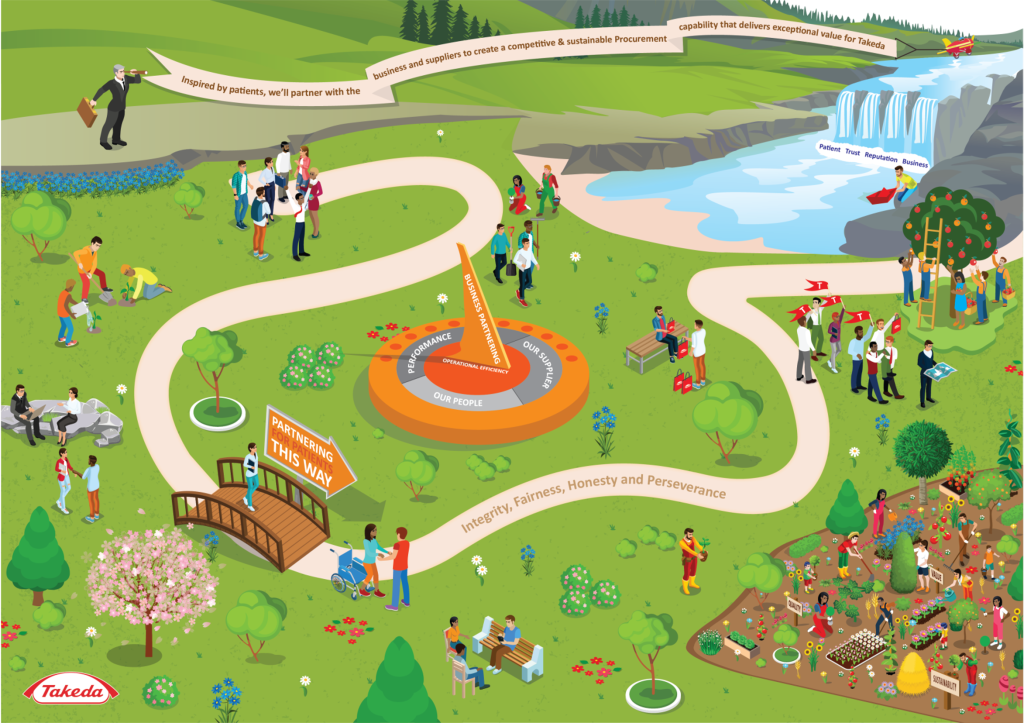
After a few hours we had one picture: a headline roadmap from the old way of working, through the pilot, to the future it would create for colleagues and customers.
Together we shaped speaking points for a narrative, built around the three questions every colleague asks. Who are we? Where are we going? What does it mean for me?
And because we deliberately chose a workspace in the heart of the open-plan office, curious colleagues kept popping in to ask what we were doing. Our workshop became a real-time focus group, building buy-in before the story had even left the room.
- Banned PowerPoint and swapped 60 slides for conversation.
- Asked three questions to find the story behind the change.
- Worked with two artists to draw the roadmap live.
- Wrote the narrative so anyone could tell the story.
Turned passing colleagues into an instant focus group.
The impact
By the end of the day, the team had a 12-foot mural of a simple, colourful change journey under one headline. We also had a series of video of speakers walking beside the visual and explaining key themes.
It focused on people: what was needed from them, and the difference their support would make. With the narrative in hand, they could tell the whole story in a couple of minutes. Even our artists, with no prior knowledge of the programme, could explain it to passers-by. Why – because we remember a story we’ve seen and heard far more than a slide deck we’ve sat through.
This was one of the best days in the programme’s history. The output was great, but the learnings were priceless.
Nicola, Head of Internal Communications.
The mural was digitised and used in induction and refresher training, and the approach has since been repeated on other projects.
Results
- 12foot, one picture of the whole change journey
- 60slides, replaced by one conversation
- 2minutes to tell the full story